Raw Shea Chamomile & Argan Oil Baby Lotion
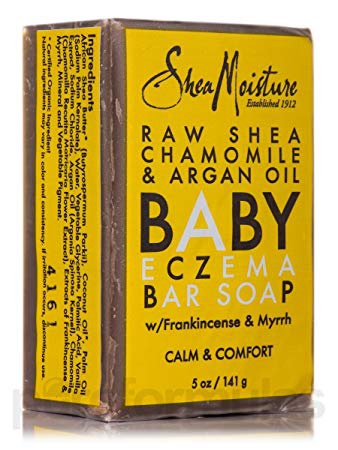
Raw Shea Chamomile & Argan Oil Baby Eczema Bar Lather West/ Frankincense And Myrrh
ORGANIC CARE FOR SENSITIVE Baby Skin: Created With Certified Organic Ingredients Keeping In Mind Your Baby's Tender And Sensitive Peel. SheaMoisture's Raw Shea Butter Baby Eczema Bar Soap is a nutrient-rich bar soap designed to relieve symptoms of eczema. Gentle enough for everyday employ.
Uploaded past: aflandies on
Ingredients overview
Sodium Palmate, Sodium Palm Kernelate, Water (Aqua), Glycerin, Butyrospermum Parkii*♥, Fragrance (Parfum), Sodium Gluconate, Palm Acid, Sodium Chloride, Palm Kernel Acid, Argania Spinosa Kernel Oil, Iron Oxides (Ci 77492), Iron Oxides (Ci 77491), Iron Oxides (Ci 77499), Chamomilla Recutita (Matricaria) Leaf Extract
Highlights
Central Ingredients
Other Ingredients
Skim through
| Ingredient name | what-information technology-does | irr., com. | ID-Rating |
|---|---|---|---|
| Sodium Palmate | emulsifying, surfactant/cleansing, viscosity controlling | ||
| Sodium Palm Kernelate | emulsifying, surfactant/cleansing, viscosity controlling | ||
| Water (Aqua) | solvent | ||
| Glycerin | skin-identical ingredient, moisturizer/humectant | 0, 0 | superstar |
| Butyrospermum Parkii*♥ | emollient, viscosity decision-making | goodie | |
| Fragrance (Parfum) | perfuming | icky | |
| Sodium Gluconate | chelating, moisturizer/humectant | ||
| Palm Acid | surfactant/cleansing, emulsifying | ||
| Sodium Chloride | viscosity decision-making | ||
| Palm Kernel Acid | surfactant/cleansing, emulsifying | ||
| Argania Spinosa Kernel Oil | antioxidant, emollient | goodie | |
| Atomic number 26 Oxides (Ci 77492) | colorant | 0, 0 | |
| Iron Oxides (Ci 77491) | colorant | 0, 0 | |
| Iron Oxides (Ci 77499) | colorant | 0, 0 | |
| Chamomilla Recutita (Matricaria) Leafage Extract |
Shea Moisture Raw Shea Chamomile & Argan Oil Baby Eczema Bar Soap W/ Frankincense And Myrrh
Ingredients explained  We don't have description for this ingredient yet.
Nosotros don't accept description for this ingredient even so.
Also-called: Aqua | What-it-does: solvent
Good old water, aka H2o. The most common skincare ingredient of all. You lot can commonly find it right in the very start spot of the ingredient list, meaning it's the biggest thing out of all the stuff that makes upwards the product.
It's mainly a solvent for ingredients that do non similar to dissolve in oils merely rather in h2o.
Once inside the skin, it hydrates, but not from the outside - putting pure water on the pare (hello long baths!) is drying.
I more than thing: the h2o used in cosmetics is purified and deionized (it means that virtually all of the mineral ions inside it is removed). Like this, the products can stay more stable over time.
- A natural moisturizer that's also in our skin
- A super common, safe, effective and cheap molecule used for more than 50 years
- Not only a simple moisturizer just knows much more: keeps the peel lipids between our skin cells in a healthy (liquid crystal) state, protects against irritation, helps to restore barrier
- Effective from as depression as 3% with even more than benefits at higher concentrations up to xx-40% (effectually 10% is a good usability-effectiveness sweet spot)
- Loftier-glycerin moisturizers are crawly for treating severely dry out skin
Read all the geeky details about Glycerin here >>
Unless you lot live under a rock you must have heard about shea butter. Information technology'south probably the nigh hyped up natural butter in skincare today. It comes from the seeds of African Shea or Karite Trees and used every bit a magic moisturizer and emollient.
But it's not only a simple emollient, it regenerates and soothes the skin, protects information technology from external factors (such as UV rays or current of air) and is as well rich in antioxidants (amid others vitamin A, E, F, quercetin and epigallocatechin gallate). If you are looking for rich emollient benefits + more, shea is difficult to beat.
As well-called: Fragrance, Parfum;Parfum/Fragrance | What-it-does: perfuming
Exactly what it sounds: nice smelling stuff put into corrective products so that the end product also smells nice. Fragrance in the US and parfum in the EU is a generic term on the ingredient list that is made upwards of 30 to 50 chemicals on boilerplate (simply information technology can have as much as 200 components!).
If yous are someone who likes to know what you put on your face up then fragrance is not your all-time friend - in that location'south no way to know what's really in it.
Likewise, if your skin is sensitive, fragrance is once more not your all-time friend. Information technology'due south the number one crusade of contact allergy to cosmetics. It's definitely a smart thing to avoid with sensitive skin (and fragrance of any type - natural is merely as allergic equally synthetic, if not worse!).
The neutralized course of gluconic acid. It's a peachy ingredient to neutralize metal (specially iron and copper) ions in a cosmetic production. This helps to prevent discoloration of the formula over fourth dimension or rancidity of corrective oils. It tin besides be a pH regulator and a humectant (helps pare to cling onto water).
It's too used in oral care products where it reduces the bitterness of other ingredients. And it'due south natural, both Ecocert and Cosmos approved. (source: manufacturer info)
Nosotros don't have description for this ingredient yet.
Sodium chloride is the fancy name of salt. Normal, everyday table salt.
If (similar to us) you are in the weird habit of reading the characterization on your shower gel while taking a shower, you might take noticed that sodium chloride is nigh e'er on the ingredient list. The reason for this is that common salt acts as a fantastic thickener in cleansing formulas created with ionic cleansing agents (aka surfactants) such as Sodium Laureth Sulfate. A couple of percents (typically 1-3%) turns a runny surfactant solution into a nice gel texture.
If you are into chemistry (if non, we empathise, just skip this paragraph), the reason is that electrolytes (you know, the Na+ and Cl- ions) screen the electrostatic repulsion between the head groups of ionic surfactants and thus support the germination of long shaped micelles (instead of spherical ones) that entangle similar spaghetti, and viola, a gel is formed. Notwithstanding, too much of it causes the phenomenon chosen "salting out", and the surfactant solution goes runny again.
Other than that, salt also works as an emulsion stabilizer in water-in-oil emulsions, that is when water aerosol are dispersed in the outer oil (or silicone) phase. And last but non least, when salt is right at the first spot of the ingredient listing (and is non dissolved), the product is usually a body scrub where table salt is thephysical exfoliating agent.
Nosotros don't have description for this ingredient yet.
When it comes to corrective oils and hype, argan oil is for certain leading the way. Dubbed as the "liquid gold of Morocco", we have to admit we take some trouble determining why this oil enjoys such a special miracle status. Non that it's not good, it is expert, even cracking but reading the research about argan and a bunch of other plant oils nosotros just do not run across the large, unique differentiating factor (though that might be our fault not reading enough, obvs.)
Then, argan oil comes from the kernel of the argan fruit that comes from the argan tree that grows just in Morocco. The tree is dull growing and getting the oil is a difficult job. The traditional process is that the ripe argan fruits fall from the tree, then goats eat them upwardly and poop out the seeds. The seeds are collected and smashed with a stone to get the kernels inside. This part is the hard i as the seeds have extremely hard shells. Once the kernels are obtained, the oil is pressed out from them (the kernels contain about 50% oil).
Every bit for skincare, argan oil is loaded with lots of skin goodies (but so are many other establish oils): it contains eighty% nourishing and moisturizing unsaturated fatty acids, mainly oleic (38-50%), linoleic (28-38%) and palmitic (10-18%). It as well contains a relatively big amount of antioxidant vitamin Eastward (600-900 mg/kg, most twice every bit much as olive), small-scale amounts of antioxidant phenols (including caffeic acid, ferulic acrid, and epicatechin), every bit well as some rare sterols with soothing and anti-inflammatory properties.
Thank you to all the in a higher place goodness in argan oil, it can greatly nourish and moisturize the skin and hair. It's also claimed to be able to neutralize collagen-dissentious costless radicals, help reduce scars, and revitalize and better skin elasticity. You can even read that argan might help acne-decumbent skin, but being a loftier oleic oil, we would exist conscientious with that.
All in all, argan oil is a real goodie simply we do not fully sympathise the special miracle status it enjoys.
Also-called: Ci 77491/77492/77499 | What-it-does: colorant | Irritancy: 0 | Comedogenicity: 0
A bit of a sloppy ingredient name as it covers not 1 but 3 pigments: cherry, yellow and blackness fe oxide.
The trio is invaluable for "peel-colored" makeup products (think your foundation and pressed pulverization) equally blending these 3 shades carefully can produce almost whatsoever shade of natural-looking flesh tones.
Also-chosen: Ci 77491/77492/77499 | What-it-does: colorant | Irritancy: 0 | Comedogenicity: 0
A scrap of a sloppy ingredient proper name as information technology covers not one merely three pigments: red, yellowish and black atomic number 26 oxide.
The trio is invaluable for "skin-colored" makeup products (think your foundation and pressed powder) as blending these three shades carefully can produce almost any shade of natural-looking flesh tones.
Also-called: Ci 77491/77492/77499 | What-information technology-does: colorant | Irritancy: 0 | Comedogenicity: 0
A scrap of a sloppy ingredient name as it covers not i simply three pigments: ruby-red, xanthous and black iron oxide.
The trio is invaluable for "skin-colored" makeup products (recall your foundation and pressed pulverisation) equally blending these iii shades advisedly can produce well-nigh any shade of natural-looking flesh tones.
We don't take description for this ingredient yet.
You may also want to accept a look at...
Normal (well kind of - it's purified and deionized) h2o. Usually the main solvent in cosmetic products. [more] A real oldie only a goodie. Keen natural moisturizer and skin-identical ingredient that plays an important role in peel hydration and general peel wellness. [more than] Shea butter that'southward considered to be a magic moisturizer and emollient. It is also soothing and rich in antioxidants. [more than] The generic term for nice smelling stuff put into corrective products and then that the end product besides smells dainty. Information technology is fabricated up of 30 to 50 chemicals on average. [more] The neutralized form of gluconic acrid. It's a peachy ingredient to neutralize metal (especially iron and copper) ions in a cosmetic product. This helps to foreclose discoloration of the formula over time or rancidity of corrective oils. [more] Sodium chloride is the fancy proper name of salt. Normal, everyday table common salt. If (like to us) y'all are in the weird addiction of reading the label on your shower gel while taking a shower, y'all might have noticed that sodium chloride is almost always on the ingredient list. [more than] Argan oil - the "liquid gold of Morocco" that contains 80% unsaturated fat acids (oleic and linoleic mainly), and antioxidant vitamin E and phenols. Information technology'south highly nourishing and moisturizing both for peel and pilus. [more] A mix of red, yellow and black iron oxide. [more] A mix of red, yellow and black iron oxide. [more than] A mix of cherry, yellow and black iron oxide. [more]
Raw Shea Chamomile & Argan Oil Baby Lotion
Source: https://incidecoder.com/products/shea-moisture-raw-shea-chamomile-argan-oil-baby-eczema-bar-soap-w-frankincense-and-myrrh
0 Response to "Raw Shea Chamomile & Argan Oil Baby Lotion"
Post a Comment