What Kinds of Telescopes Use a Lens to Gather and Collect Light?
Lesson Objectives
- Explain how astronomers use the whole electromagnetic spectrum to study the universe beyond Globe.
- Identify different types of telescopes.
- Describe historical and mod observations made with telescopes.
Vocabulary
- astronomer
- catadioptric telescope
- constellation
- electromagnetic (EM) radiation
- electromagnetic spectrum
- frequency
- gamma ray
- infrared light
- low-cal-twelvemonth
- microwave
- planet
- radio telescope
- radio moving ridge
- reflecting telescope
- refracting telescope
- infinite telescope
- spectrometer
- ultraviolet (UV)
- visible light
- wavelength
- X-ray
Introduction
Many scientists collaborate directly with what they are studying. Biologists can collect cells, seeds, or sea urchins and put them in a controlled laboratory environment. Physicists tin can subject metals to stress or smash atoms into each other. Geologists tin can chip away at rocks to see what is inside. Butastronomers, scientists who study the universe across Earth, rarely have a take a chance for direct contact with their subject. Astronomers observe their subjects at a distance, usually a very big distance!
Electromagnetic Radiation
Earth is separated from the balance of the universe past very large expanses of space. Very rarely affair from outside Earth's environment reaches us, such equally when a meteorite makes it through the temper from elsewhere in the solar system. But for the most function, astronomers have i main source for their information — light. Lite can travel across empty infinite, and as information technology does, and then information technology carries both energy and data. Light is one type ofelectromagnetic (EM) radiation, energy that is transmitted through infinite as a moving ridge.
These videos discuss infrared, ultraviolet, and radio telescopes, as well as telescopes that detect visible light, and reveal tremendous features of the stars and galaxies around the Universe(2d): http://world wide web.youtube.com/watch?v=AK-gtuAJ-B4 (two:xix), http://www.youtube.com/lookout?5=aQJQH7lS27s (5:xxx).
The Speed of Light
Light travels faster than anything else in the universe. In the near completely empty vacuum of space, lite travels at a speed of approximately 300,000,000 meters per second (670,000,000 miles per hour). To give you an idea of how fast that is, a beam of calorie-free could travel from New York to Los Angeles and dorsum again nearly xl times in just one second. Even though lite travels extremely fast, objects in infinite are so far away that it takes a significant amount of fourth dimension for light from those objects to accomplish us. For example, light from the Sun takes about 8 minutes to attain World.
Light-Years
Since astronomical distances are so large, information technology helps to have a unit that is good for expressing those big distances. Alight-twelvemonth is a unit of altitude that is defined as the distance that calorie-free travels in one year. I light-year is approximately equal to 9,500,000,000,000 (9.v trillion) kilometers, or 5,900,000,000,000 (5.9 trillion) miles (Effigy below). That's a long way! But by astronomical standards, it's actually a pretty brusk distance.
Proxima Centauri, the closest star to u.s.a. after the Sun, is 4.22 calorie-free-years away. That means the light from Proxima Centauri takes four.22 years to reach u.s.. The galaxy nosotros live in, the Milky way Galaxy, is about 100,000 light-years across. How long does information technology take lite to travel from i side of the galaxy to the other? 100,000 years! If an astronomer looks through a telescope at a star that is one,000 light years abroad, is she seeing the star as information technology is now?

The smallest red-shifted galaxies are among the most distant galaxies we have detected then far at thirteen billion light-years away. That'south over a hundred-billion-trillion (100,000,000,000,000,000,000,000) kilometers!
Looking Back in Time
When nosotros look at astronomical objects such as stars and galaxies, we are not simply seeing over keen distances—we are likewise seeing back in time. Because low-cal takes time to travel, the image nosotros see of a afar galaxy is an prototype of how the galaxy used to look. For case, the Andromeda Galaxy, shown in (Effigy below), is virtually 2.5 meg calorie-free years from Earth. If you expect at the Andromeda Galaxy through a telescope, what are you seeing? You are seeing the galaxy as it was 2.five million years ago. If the galaxy ceased to exist 1 million years ago, when would you know that? If you want to see the galaxy as it is now, you lot will have to look and wait again 2.5 million years into the future.

This recent flick of the Andromeda Galaxy actually shows the milky way equally information technology was about 2.5 million years ago.
Electromagnetic Waves
Light is ane type of EM radiation; calorie-free is energy that travels in the form of anelectromagnetic wave. (Figure below) shows a diagram of an electromagnetic moving ridge. An EM wave has two components: an electric field and a magnetic field. Each of these components oscillates between positive and negative values, which is what makes the "wavy" shape in the diagram.
The distance between 2 adjacent oscillations is calledwavelength. A related value isfrequency, which measures the number of wavelengths that pass a given point every second. Wavelength and frequency are reciprocal, which ways that as ane increases, the other decreases.

An electromagnetic wave consists of oscillating electric and magnetic fields.
The Electromagnetic Spectrum
Visible lite — the light that man optics can run into — comes in a variety of colors. The color of visible light is determined by its wavelength. Visible light ranges from wavelengths of 400 nm to 700 nm, respective to the colors violet through cerise. EM radiation with wavelengths shorter than 400 nm or longer than 700 nm exists all around you — you lot merely can't see information technology. The total range of electromagnetic radiation, or theelectromagnetic spectrum, is shown inFigure below.

(a) Visible lite is part of the electromagnetic spectrum, which ranges from gamma rays with very brusk wavelengths, to radio waves with very long wavelengths. (b) These are images of the same scene. In the elevation, simply the wavelengths of visible light evidence. In the bottom, a layer of thick clouds appears in the infrared wavelengths.
Similar our Sunday, every star emits light at a wide range of wavelengths, all across the visible spectrum and even exterior the visible spectrum. Astronomers can larn a lot from studying the details of the spectrum of calorie-free from a star.
Some very hot stars emit light primarily atultraviolet (UV) wavelengths, while some very cool stars emit generally in theinfrared. There are extremely hot objects that emitX-rays and fifty-fiftygamma rays. Lite from some of the faintest, nigh distant objects is in the course ofradio waves. In fact, a lot of the objects most interesting to astronomers today can't even be seen with the naked middle. Astronomers employ telescopes to detect the faint calorie-free from distant objects and to see objects at wavelengths all across the electromagnetic spectrum.
To larn more about star's spectra, check out http://www.colorado.edu/physics/PhysicsInitiative/Physics2000/quantumzone/.
Types of Telescopes
Optical Telescopes
People have been making and using lenses for magnification for thousands of years. However, the first true telescopes were made in Europe in the belatedly 16th century. These telescopes used a combination of ii lenses to make afar objects appear both nearer and larger. The termtelescopewas coined by the Italian scientist and mathematician Galileo Galilei (1564–1642). Galileo built his outset telescope in 1608 and subsequently made many improvements to telescope blueprint.
Telescopes that rely on the refraction, or bending, of light by lenses are calledrefracting telescopes, or simplyrefractors. The primeval telescopes, including Galileo's, were all refractors. Many of the small telescopes used past apprentice astronomers today are refractors. Refractors are particularly skillful for viewing details within our solar organisation, such equally the surface of Earth's moon or the rings around Saturn (Effigy below).

The largest refracting telescope in the world is at the University of Chicago's Yerkes Observatory in Wisconsin and was built in 1897. Its largest lens has a diameter of 102 cm.
Around 1670, some other famous scientist and mathematician — Sir Isaac Newton (1643–1727) — built a different kind of telescope. Newton used curved mirrors to focus light and so created the beginningreflecting telescopes, orreflectors (Figure below). The mirrors in a reflecting telescope are much lighter than the heavy glass lenses in a refractor. This is significant, because:
- To back up the thick glass lenses a refractor must be strong and heavy.
- Mirrors are easier to make precisely than information technology is to make drinking glass lenses.
- Because they practise not need to exist as heavy to support the same size lens, reflectors can be made larger than refractors.
Larger telescopes tin collect more lite and then they can written report dimmer or more distant objects. The largest optical telescopes in the world today are reflectors.

(a) Reflecting telescopes used past amateur astronomers today are like to the i designed past Isaac Newton in the 17th century. (b) The South African Big Telescope (Salt) is 1 of the largest reflecting telescopes on Globe. Table salt's chief mirror consists of 91 smaller hexagonal mirrors, each with sides i m long. (c) Many amateur astronomers today use catadioptric telescopes.
Catadioptric telescopes accept a combination of mirrors and lenses to focus light. Catadioptric telescopes take large mirrors to collect a lot of low-cal, but short tubes for portability.
KQED: Amateur Astronomers
Amateur astronomers enjoy observing and studying stars and other celestial objects. Both professional and amateur astronomers use telescopes. A telescope is an instrument that makes faraway objects expect closer. Learn more than at: http://science.kqed.org/quest/video/amateur-astronomers/.
Radio Telescopes
Notice information technology says to a higher place that the largestoptical telescopes in the earth are reflectors. Optical telescopes collect visible light. Fifty-fifty larger telescopes are built to collect calorie-free at longer wavelengths — radio waves. What exercise you lot think these telescopes are chosen?Radio telescopes expect a lot similar satellite dishes considering both are designed to practice the same thing — to collect and focus radio waves ormicrowaves (the shortest wavelength waves) from space.
The largest single telescope in the world is at the Arecibo Observatory in Puerto Rico (Figure below). This telescope is located in a naturally occurring sinkhole that formed when water flowing hole-and-corner dissolved the limestone rock. If this telescope were not supported by the ground, it would collapse under its ain weight. Since the telescope is fix into the footing it cannot be aimed to unlike parts of the sky and and so can but observe the part of the sky that happens to be overhead at a given fourth dimension.

The radio telescope at the Arecibo Observatory has a diameter of 305 yard.
A group of radio telescopes can exist linked together with a computer then that they are all observing the aforementioned object (Figure below). The computer combines the data, making the group function like one unmarried telescope.
For more on radio telescopes and radio astronomy in full general, get to http://www.nrao.edu/whatisra/alphabetize.shtml.

The Very Large Array in New Mexico has 27 radio dishes, each 25 m in diameter. When all the dishes are pointed at the same object, they are like a single telescope with a diameter of 22.iii mi.
KQED: SETI: The New Search for ET
Scientists have upped their search for extraterrestrial intelligence with the Allen Telescope Array, a string of 350 radio telescopes, located 300 miles north of San Francisco. Find out why SETI scientists now say nosotros might be hearing from ET sooner than you recollect. Learn more at:http://science.kqed.org/quest/video/seti-the-new-search-for-et/.
KQED: Interview with Astronomer Jill Tartar
SETI listens for signs of other civilization's engineering science. Dr. Jill Tartar explains the program: What information technology's looking for; what the bug are; what the potential benefits are. Larn more than at: http://www.youtube.com/picket?v=QwEm3WHvNHI.
Infinite Telescopes
Telescopes on Earth all have 1 pregnant limitation: the electromagnetic radiation they get together must pass through World's temper. The atmosphere blocks some radiation in the infrared part of the spectrum and almost all radiation in the ultraviolet and higher frequency ranges. Furthermore, motion in the atmosphere distorts light. That distortion is why stars twinkle in the night sky. To minimize these issues, many observatories are built on loftier mountains, where at that place is less atmosphere higher up the telescope. Even better,space telescopes avert such bug completely because they orbit outside Earth'due south atmosphere in space. Space telescopes can behave instruments to detect objects emitting various types of electromagnetic radiation such as visible, infrared or ultraviolet low-cal; gamma rays; or x-rays. X-ray telescopes, such as the Chandra Ten-ray Observatory, use 10-ray eyes to observe remote objects in the X-ray spectrum.
The Hubble Space Telescope (HST), shown in (Figure below), is peradventure the best known space telescope. The Hubble was put into orbit past the Space Shuttle Atlantis in 1990. Once information technology was in orbit, scientists discovered that there was a flaw in the shape of the mirror. A servicing mission to the Hubble by the Space Shuttle Try in 1994 corrected the problem. Since that time, the Hubble has provided huge amounts of information that have helped to answer many of the biggest questions in astronomy.
Observe out more past visiting the Hubble Space Telescope website at http://hubblesite.org.

(a) The Hubble Space Telescope orbits World at an altitude of 589 km (366 mi). It collects information in visible, infrared, and ultraviolet wavelengths. (b) This starburst cluster is one of the many fantastic images taken past the HST over the past ii decades.
The National Aeronautics and Space Administration (NASA) has placed iii other major space telescopes in orbit, comprising what NASA calls the 'Dandy Observatories'. Each of these telescopes specializes in a dissimilar part of the electromagnetic spectrum (Figure below). NASA is planning for another telescope, the James Webb Space Telescope, to serve as a replacement for the aging Hubble. The James Webb is scheduled to launch in 2018.
To acquire more almost NASA's smashing observatories, check outhttp://www.nasa.gov/audience/forstudents/postsecondary/features/F_NASA_Great_Observatories_PS.html.

NASA'south four infinite-based Great Observatories were designed to view the universe in unlike ranges of the electromagnetic spectrum. A. Hubble Space Telescope: visible, infrared and ultraviolet calorie-free; B. Compton Gamma Ray Observatory (inactive): gamma ray; C. Spitzer Space Telescope: infrared; D. Chandra 10-ray Observatory: X-ray.
Observations with Telescopes
Aboriginal Astronomers
Humans take been studying the night sky for thousands of years. Observing the patterns and motions in the sky helped aboriginal peoples keep track of time (Effigy below). By understanding annual rhythms, people could know when to plant crops. They also timed many of their religious ceremonies to coincide with events in the heavens.

Many archaeologists remember that Stonehenge was used to find the movement of the moon and the sun.
The aboriginal Greeks made careful observations of the locations of stars in the sky. They noticed that some of the 'stars' moved confronting the background of other stars. They chosen these bright and odd bodies in the heavenplanets, which in Greek means "wanderers." Today we know that the planets are not stars, but members of our solar system that orbit the Sun. Greeks as well identifiedconstellations, patterns of stars in the sky (Figure beneath). They associated the constellations with stories and myths from their culture.
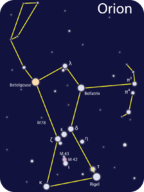
Stars in the constellation Orion. Constellations assist astronomers today identify different regions of the night sky.
Galileo's Observations
Aboriginal astronomers knew a lot well-nigh the patterns of stars and the movement of objects in the heaven, merely they did not know what these objects actually were. That understanding began in the year 1610, when Galileo turned a telescope toward the heavens. With his telescope, Galileo made the following discoveries (among others):
- There are more than stars in the nighttime sky than the naked eye tin can see.
- The band of stars called the Milky Way consists of many stars.
- The Moon has craters (Figure beneath).
- Venus has phases like the Moon.
- Jupiter has orbiting moons.
- There are nighttime spots that move across the surface of the Sun.

Galileo was the first person known to look at the Moon through a telescope. Galileo fabricated the drawing on the left in 1610; on the correct is a modern photograph of the Moon.
Galileo's observations challenged people to think in new means almost the universe and Earth's place in it. About 100 years earlier Galileo, Nicolaus Copernicus had proposed a controversial new model of the universe in which Earth and the other planets revolve around the Sun. In Galileo'southward time, most people withal believed that the Sun and planets revolved effectually Earth. Galileo'south observations provided directly evidence to back up Copernicus' model.
Observations with Modern Telescopes
Equipped with no more than than a expert pair of binoculars, you can see all of the things Galileo saw, and more. You lot can fifty-fifty see sunspots, just be certain to use special filters on the lenses to protect your eyes. With a basic telescope like those used by many amateur astronomers, you can see more than than Galileo saw, such every bit polar caps on Mars, the rings of Saturn, and bands in the atmosphere of Jupiter.
All of the objects mentioned above are within our solar system. With a telescope y'all tin can also see many times more than stars than without a telescope. However, because they are then far away, the stars volition appear equally points of light. This is true fifty-fifty of the most powerful professional telescopes, with 1 rare exception (Figure beneath).

This ultraviolet image of the crimson supergiant star Betelgeuse taken with the Hubble Space Telescope in 1996 was the first directly image taken of the disk of a star other than the Sun.
Very few professional person astronomers today wait straight through the eyepiece of a telescope. Instead, they attach to the telescopes sophisticated instruments that capture and procedure the light. The astronomers and then look at the images or data shown on these instruments. Near often the instruments then laissez passer the data on to a computer where the data can be stored for later on utilise. An astronomer may accept weeks or months to analyze all the data collected from just a single night.
Astronomers utilisespectrometers to report the light from a telescope. A spectrometer uses a prism or other device to interruption low-cal down into its component colors. The spectrum produced tin be observed straight, captured on film, or stored digitally on a computer (Figure beneath).

A simplified instance of starlight afterward it passes through a spectrometer. The dark lines in a star'due south spectrum are caused by gases absorbing light in the star'southward outer atmosphere.
From a single spectrum of a star, an astronomer can tell:
- How hot the star is (by the relative effulgence of different colors).
- What elements the star contains (past the pattern of dark lines).
- Whether and how fast the star is moving toward or away from Globe (past how far the dark lines are shifted from their normal positions).
Using telescopes, astronomers can as well acquire how stars evolve, what kind of matter is constitute throughout the universe, how that thing is distributed, and fifty-fifty how the universe might take formed.
Lesson Summary
- Astronomers report light from distant objects.
- Light travels at 300,000,000 meters per 2nd — faster than annihilation else in the universe.
- A light-yr is equal to the distance light travels in ane year, 9.5 trillion kilometers.
- When we see distant objects, we see them as they were in the past, considering their light has been traveling to us for many years.
- Visible lite is part of the electromagnetic spectrum.
- Telescopes brand afar objects appear both nearer and larger.
- Optical telescopes collect visible light. The three master types are reflecting telescopes, refracting telescopes, and catadioptric telescopes.
- Radio telescopes collect and focus radio waves from distant objects.
- Space telescopes orbit Earth, collecting wavelengths of light that are ordinarily blocked past the atmosphere.
- Galileo was the first person known to use a telescope to study the sky. His discoveries helped change the way humans call back about the universe.
- Modern telescopes collect data that tin be stored on a computer.
- Astronomers can learn a lot about a star by studying its spectrum.
Review Questions
- Betelgeuse is effectually 640 light-years from Earth. Low-cal travels nine.five trillion kilometers in one year. How far away is Betelgeuse in kilometers?
- Identify four regions of the electromagnetic spectrum that astronomers use when observing objects in infinite.
- List the three main types of optical telescopes, and describe their differences.
- Explicate the advantages of putting a telescope into orbit effectually Globe.
- Depict ii observations that Galileo was the first to make with his telescope.
- List 3 things that an astronomer can learn well-nigh a star by studying its spectrum.
Further Reading / Supplemental Links
- Lots of news and information from NASA at http://www.nasa.gov/
- The showtime stars in the Universe: http://scientific discipline.nasa.gov/headlines/y2002/08feb_gravlens.htm
- How many stars can you detect? http://world wide web.stargazing.cyberspace/David/constel/howmanystars.html
- Archeastronomy: http://world wide web.astronomy.pomona.edu/archeo/
- An activity found online with directions for how to decide if that bright point you see in the sky is a planet or a star:http://cse.ssl.berkeley.edu/SegwayEd/lessons/findplanets/Observe-hmpg2.html
Points to Consider
- Radio waves are used for communicating with spacecraft. A circular-trip communication from Earth to Mars takes anywhere from half dozen to 42 minutes. What challenges does this present for sending unmanned spacecraft and probes to Mars?
- The Hubble Space Telescope is a very important source of data for astronomers. The fascinating and beautiful images from the Hubble also help to maintain public support for science. However, the Hubble is growing old. Missions to service and maintain the telescope are extremely expensive and put the lives of astronauts at risk. Practice you lot retrieve there should be another servicing mission to the Hubble?
Source: https://courses.lumenlearning.com/earthscience/chapter/telescopes/
0 Response to "What Kinds of Telescopes Use a Lens to Gather and Collect Light?"
Post a Comment